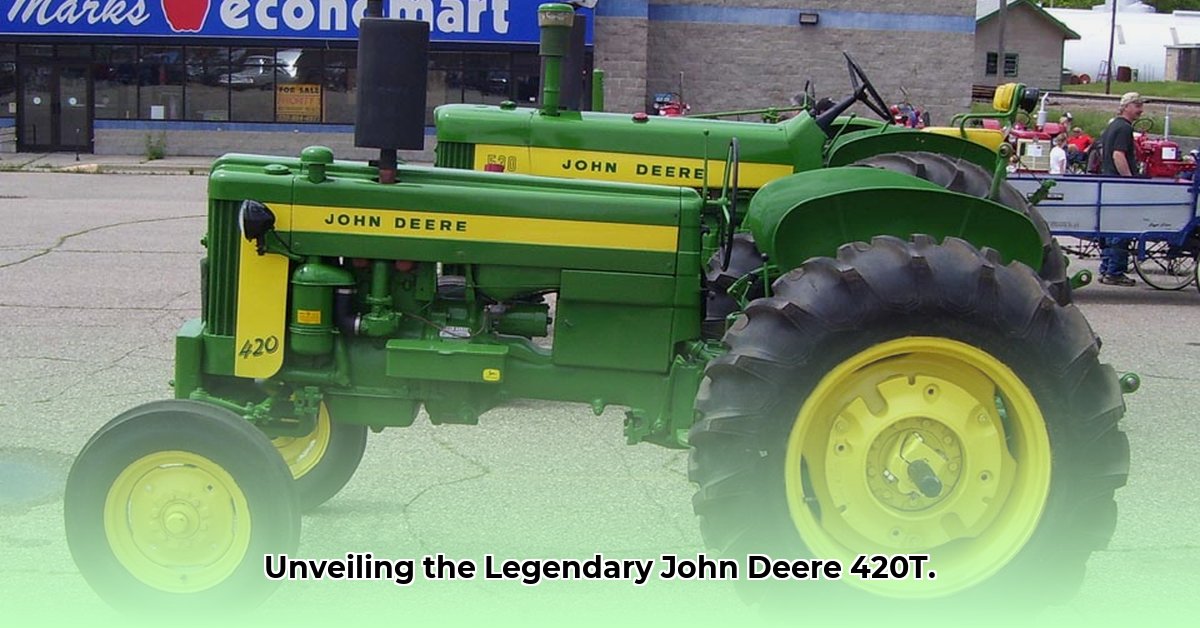
The John Deere 420T tractor, produced between 1956 and 1958, represents a significant milestone in the evolution of agricultural machinery. This analysis examines its historical context, technical specifications, and lasting impact on farming practices during a period of significant mechanization. While not possessing the immense power of modern tractors, the 420T’s adaptability and reliability solidified its place in the agricultural landscape of the late 1950s. For sale listings, check out this helpful resource.
The 420 Series: A Family of Workhorses
The 420T was not an isolated model but part of the broader John Deere 420 series, demonstrating a key shift towards customization in agricultural equipment. Variations such as the 420W, 420U, 420S, 420H, and 420V catered to diverse farming needs and terrains. The availability of "Hi-Crop" and "Crawler" versions further highlighted Deere's commitment to providing tractors tailored to specific operational requirements. This strategy reflected a growing awareness of the varied challenges faced by farmers across different geographical locations and cropping systems. Wasn't this adaptability a significant advantage in a market yet to fully embrace mass-produced uniformity?
Power and Propulsion: Fueling the Fields
The 420T typically employed a two-cylinder engine, a prevalent design for tractors of its era. However, Deere offered noteworthy flexibility in fuel choices. Farmers could select gasoline, an "all-fuel" blend (reflecting the era's experimentation with fuel types), or even liquefied petroleum gas (LPG). This variety of fuel options showcased the practical considerations influencing tractor design during a time of evolving energy sources. The horsepower output, while modest by present-day standards (approximately 26–28 horsepower depending on the measurement method), was sufficient for the agricultural tasks of the time. How effectively did this power output compare to competitors' offerings of that era?
Technological Features and Operational Considerations
The 420T incorporated several notable features for its time. The "Hi-Crop" model, with its increased ground clearance, was particularly well-suited to taller crops, enhancing efficiency in harvesting. The tracked "Crawler" version provided superior traction and maneuverability on challenging terrain, widening the tractor's operational scope. However, the unsynchronized transmission presented a key limitation. This feature required significant operator skill and precision during gear changes, potentially slowing down operations and demanding greater expertise from the farmer. Did this unsynchronized transmission hinder its overall market appeal, or did its other features compensate?
Production and Market Performance
An estimated 27,000 units of the entire 420 series were produced, a considerable number indicative of substantial market penetration. Precise sales figures, however, remain elusive due to the limitations of historic data collection. Determining its precise market share relative to competitors requires further investigation, which is limited by the lack of complete archival information detailing the sales performance of agricultural equipment during this era. Despite the challenges in obtaining an accurate market position, the substantial production run certainly denotes a successful product. How could future research improve our understanding of the 420's market standing?
Enduring Legacy and Historical Significance
The John Deere 420T, despite its technical constraints, played a crucial role in the mechanization of American agriculture during the mid-20th century. Its versatility, through various configurations, catered to a diverse range of farming practices. While not revolutionary in its design, its reliable performance and adaptability made it a valuable asset for countless farmers. Its lasting impact lies in its contribution to the evolution of more powerful and technologically sophisticated farm equipment that followed. What aspects of the 420T's design foreshadowed future advancements in agricultural machinery?
Specifications Summary
| Feature | Specification | Notes |
|---|---|---|
| Engine | 2-cylinder; Gasoline, All-Fuel, LPG options | Fuel flexibility reflected the varied resources and preferences of farmers. |
| Horsepower | ~26-28 hp (drawbar/belt) | Power output appropriate for the typical tasks of the period. |
| Transmission | Unsynchronized | Required skill and careful operation from the driver. |
| Variants | W, T, U, S, H, V, Hi-Crop, Crawler | Models tailored to diverse farming needs and terrain conditions. |
| Approximate Production | ~27,000 units (420 series) | A significant production run, indicating considerable market success. |
The John Deere 420T stands as a testament to the incremental progress in agricultural technology. Its story underscores the continuous evolution of farm machinery, highlighting the importance of adaptability and reliability in meeting the evolving needs of farmers.